.png)


Our co-founder and CEO, Zaid Kahn, recently joined C-Tribe for a live fireside chat on a question we think about every day at Neuron Factory: why hasn't AI fully delivered on its promise for construction yet?
The conversation covered a lot of ground, from what's holding AI back in AEC today to where Knowledge Graphs are headed over the next five years. Here are the highlights.
The Problem Isn't a Lack of Data
Construction generates enormous amounts of project data: drawings, specs, RFIs, submittals, and change orders. So why does it still feel so hard to find the right information when you need it?
The data exists, but the context doesn't. Search can return documents, but not always the right answers. Whether it's drawing conflict detection or tracking how a change order ripples through a spec, most tools can retrieve a document, but very few can tell you how that document relates to everything else happening on a project.
.avif)
Most tools can retrieve a document, but very few can tell you how that document relates to everything else happening on a project, which is where the real risk lives.
Defining a Knowledge Graph
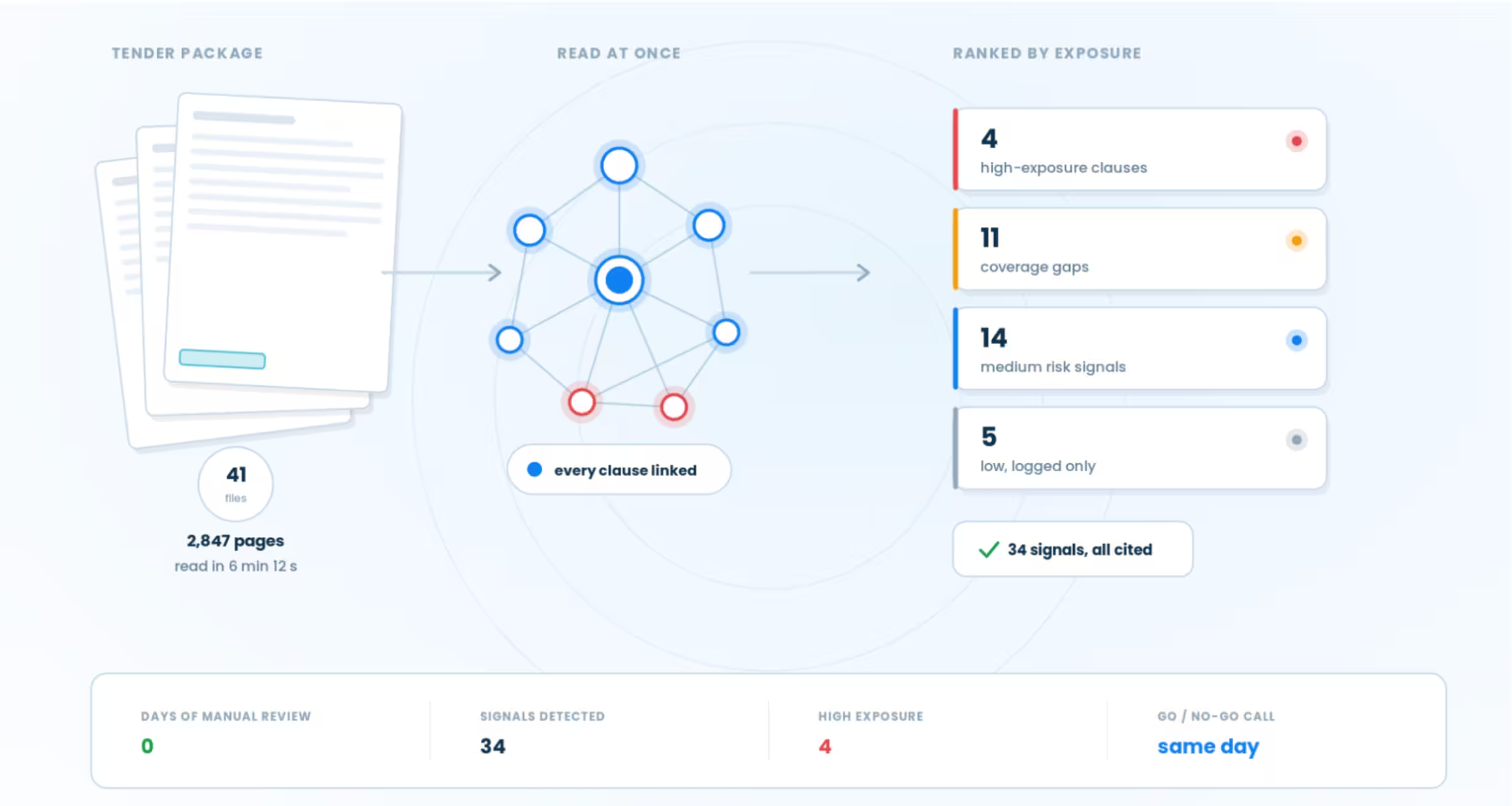
Rather than a dense technical definition, Zaid walked through Knowledge Graphs using a simple construction example: instead of treating a door spec, a floor plan, and a bill of quantities as three separate documents, a Knowledge Graph connects them as linked entities. This is the foundation of construction ontology software: modeling not just documents, but the relationships between them. Ask a question about that door spec, and the answer can resolve against all three at once, because the system understands how they relate, not just that they exist.
That distinction, understanding relationships instead of just retrieving documents, is the core of why Knowledge Graphs matter for enterprise AI.
Why LLMs Alone Aren't Enough
Large Language Models are powerful, but on their own they weren't built to hold the structured, interconnected context a construction project produces. Without a way to map how decisions, documents, and version changes relate to one another, even the best LLM is reasoning with an incomplete picture.
.avif)
This is where preconstruction knowledge graphs come in. They give AI the permanent memory and structural truth it needs to act as a "Project Historian, " reasoning across a project's history by cross-referencing and connecting information rather than just matching keywords.
The Future of Preconstruction Intelligence
Looking ahead, Zaid pointed to preconstruction as the highest-impact area for this technology. He highlighted how a shared, connected intelligence layer will allow specialized AI agents to work together off a common ground truth, automating routine, high-volume tasks. He predicted that what feels ambitious today, like an AI system that can reason across an entire project's history, will be commonplace within five years.
Getting Started
For teams wondering where to begin, the advice was highly practical: start by identifying one high-value, bounded use case, like scope gap analysis, rather than trying to boil the ocean.
Watch the complete C-TrIBE fireside chat here.
Curious what a Knowledge Graph could do for your preconstruction workflow? Book a demo to see Neuron Factory in action.
.png)